Big feelings & free printable
Free printable feelings chart for kids (English + Spanish).
For the kid who goes quiet when a feeling gets big. Print it or tap it, and let them point instead of explain.
One of my kids goes quiet when a feeling gets too big. Over time I've learned that quiet doesn't mean he has nothing to say. Sometimes he just needs another way to say it. — Anahely
01
Two Ways to Use It
Same eight feelings, same order, every time. Only the characters and colors change with the season, so your child always knows where to find each one.
Print it
Printable chart
Tape it at kid height (the fridge works great) and ask them to point to one a day. US Letter, English and Spanish on the same page.
Tap it
Feelings check-in
Free, on your phone or tablet. Your child taps a feeling, and you see the week at a glance. No account, nothing sent to us.
Open the check-in →02
Why Quiet Kids Need a Shortcut
Some kids go quiet when a feeling gets big. In public. Around people they don't know. When they're switching between two languages. It looks like stubbornness, and it isn't. For a lot of kids it's how they stay safe when they're afraid of getting it wrong.
A chart gives them a way out of the pressure. They can point instead of explain, and pointing is a real answer.
03
The Eight Feelings
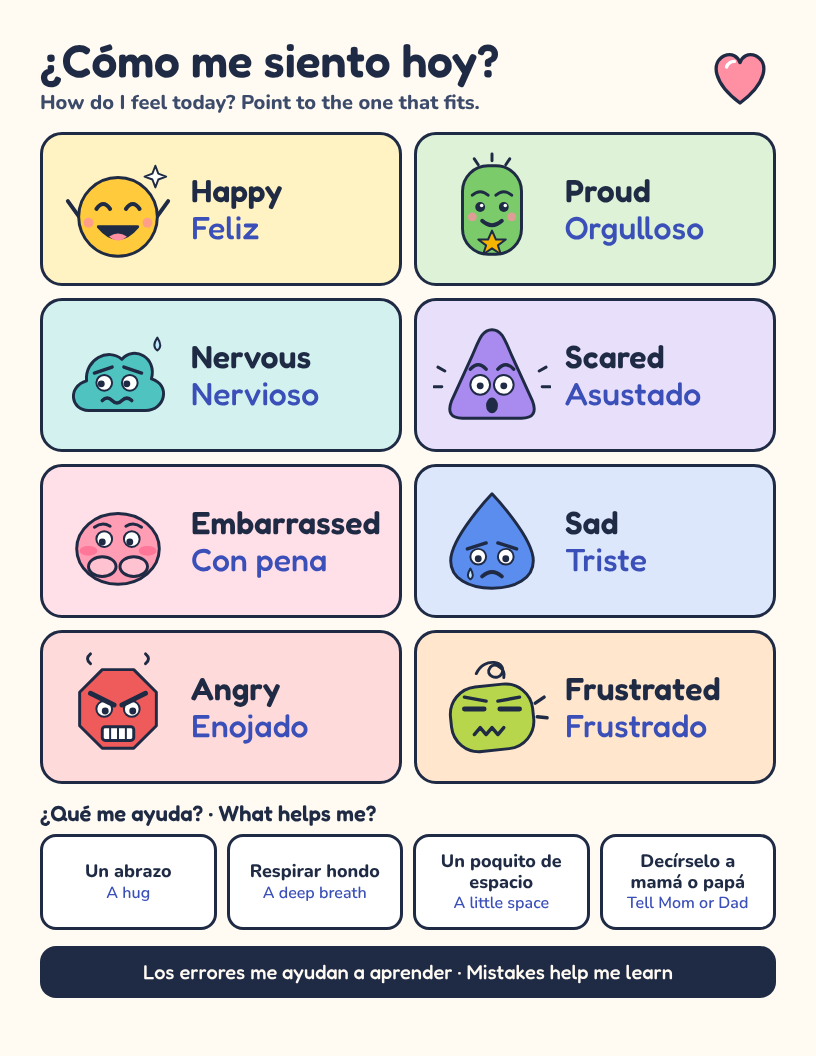
Each chart has eight original characters, and every one is labeled in English and Spanish: happy (feliz), proud (orgulloso), nervous (nervioso), scared (asustado), embarrassed (con pena), sad (triste), angry (enojado) and frustrated (frustrado).
Two choices I made on purpose:
- "Con pena." It's how so many Spanish-speaking families say that mix of shy and embarrassed. "Embarrassed" alone doesn't quite cover it, so both are there.
- "Frustrated." Kids who hate getting things wrong often feel this one before any other big feeling. It deserves its own face.
04
Five Minutes a Day
- Put it where they see it every day: the fridge, a bedroom door, or the check-in saved to your phone's home screen.
- Pick a calm moment, like after school or at bedtime. Never in the middle of a meltdown. (A feeling chart will not fix a meltdown. Trust me on that one.)
- Go first. "Today I felt nervous before my meeting." Point to Nervous.
- Ask once: "Which one is closest today?" Let them point, say a word, or pass.
- Answer with "Thanks for telling me." Skip the "why?" unless they want to explain.
Let your child choose English or Spanish. Choosing puts them in charge.
About the tap-to-pick check-in
- Your child taps a feeling. They can also tap what helps: a hug, a deep breath, a little space, telling Mom or Dad, or "I don't know."
- The Parents tab shows the week: which days they checked in and which feelings came up most. It's a way to notice patterns and start a conversation, nothing more.
- Privacy: check-ins are saved only on your device, in your browser. We never receive or see them. Clear your browser or switch phones, and the history starts over.
- Use it together at first. A screen is a tool for the conversation, not a replacement for it.
05
What to Say, and What to Skip
- Say: "It's okay to take your time." "Do you want to tell me now or later?" "I'm here."
- Skip: "Don't be shy." "Say hi!" in front of everyone. And "oh, they're just shy" when you talk about your child. Labels stick, and kids hear every word.
- Don't cheer only for the happy one. If that's the one you celebrate, kids learn to hide the rest. Every feeling is welcome here.
Make mistakes normal at home
Kids who hate being wrong learn from how you handle your own mistakes. Make a small one out loud and fix it calmly: "Oops, wrong cup. Let me try again." Praise the effort, not the perfect result: "You tried even though it was hard." And teach one phrase: "I'm still learning."
06
When to Get Extra Support
Shyness is very common in young children. The American Academy of Pediatrics says an evaluation by a child mental-health professional can help when shyness becomes so strong that it holds a child back, such as avoiding social situations, pulling away, or struggling to make friends even after a warm-up period (AAP). Talk to your pediatrician if your child:
- worries so much that it gets in the way of normal things, like going to school, playing, or sleeping alone, or the worry doesn't go away or gets worse (AAP)
- gets headaches or stomachaches mostly on school days, or avoids school. The AAP says to get professional help if school avoidance lasts more than a week (AAP)
- doesn't speak at all in certain places, like school, while talking normally at home. Cleveland Clinic describes this pattern as selective mutism (Cleveland Clinic)
This chart and check-in are ways to start a conversation. They are not a diagnosis or a treatment, and this article is parent guidance, not professional advice.
FAQs
What ages is it for?
Young children who point more than they talk. You know your child best.
Do I need to speak Spanish?
No. Every feeling is labeled in both languages.
How do I print it?
Any home printer, US Letter paper (8.5 x 11 in).
Does the check-in cost anything or need an account?
No. Free, no sign-up.
Where is my child's check-in history stored?
Only on your device. We can't see it.
Will the characters change?
A few times a year, on the printable chart and in the check-in. The eight feelings and their order never change. Bookmark this page: the current season is always at the top.
"Quiet isn't defiance. It's a kid who needs a different door into the conversation."
Get new charts and guides first.
Free guides and new posts in your inbox as soon as they are published.
Get the free guides